The AI Book Mill: A Critical Look at Mass-Publishing Software Like BookyAI
Thursday, October 22, 2026
A longtime author client emailed me with a link and one question: "Is this legit?" The link was to a sales page for something called BookyAI - software that promises to turn a topic idea into a finished, formatted book ready for Amazon KDP in a matter of minutes, with the pitch built almost entirely around "passive income" and "side hustle" language. She's published four real books with real editing behind them. She wasn't looking for a shortcut so much as she was trying to figure out if the ground had shifted under her without her noticing. So I spent some time pulling the sales page apart, reading KDP's current content policies line by line, and looking at what's actually happening to authors who've tried this at scale, searching them out on social media forums. Here's what I found.
The Bottom Line, Up Front
BookyAI is real software. It's not vaporware, and it's not a scam in the "take your money and vanish" sense. It's sold at special.bookyai.net for $67 through a third-party checkout processor, there's a support email that actually resolves to a person, and the page carries a standard 30-day refund guarantee. Treat it the way you'd treat any small indie software purchase: a real tool, viable in concept, essentially unproven at any meaningful scale.
That said, the sales page is a textbook example of aggressive info-product marketing, and it's worth naming the tactics plainly so you're evaluating the tool and not the pitch. There's an inflated bonus stack claiming "$6,064 in value" attached to a $67 purchase. There's artificial urgency pricing - "$67 today, going up to $197" - with no real deadline mechanism behind it. And the proof offered is a single case study covering two books, which is not evidence of anything repeatable. None of that makes the software fake. It does mean you should read the rest of this with your guard up.
The software works as advertised. What the sales page doesn't sell you is what happens to your KDP account six months after you start using it at volume.
Can AI-Generated Books Even Legally Go on Amazon?
Yes - with real conditions attached. KDP's content guidelines explicitly permit AI-assisted content, provided you disclose it. Amazon isn't banning AI from the publishing process; plenty of legitimate authors use AI for brainstorming, outlining, or first-draft assistance and then do substantial human work on top of it. A single, hand-curated book, where a real person has reviewed, edited, and meaningfully reshaped the output, can pass KDP's review process without issue.
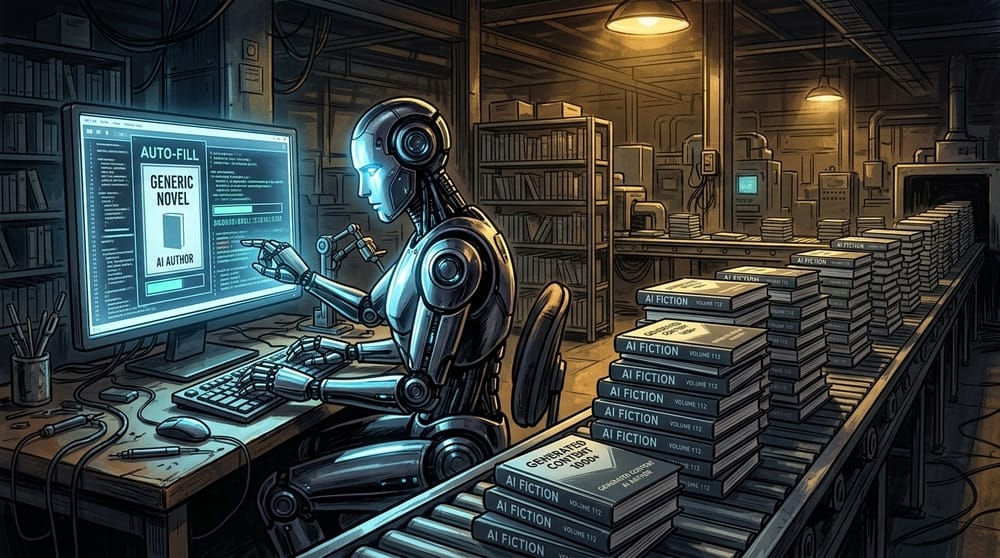
Where this breaks down is scale. The entire pitch of tools like BookyAI is the "side hustle stack" - publish ten, twenty, fifty books a month across niches, let volume do the work. That is precisely the pattern Amazon's content quality systems have gotten aggressive about catching, and it's a trend that has accelerated sharply since 2023.

Volume publishing leaves a pattern. Amazon's systems are built to find it.
The Real Caveats - More Important Than Anything on the Sales Page
None of these are hidden or secret. They're in KDP's public content guidelines. But they're also nowhere on the sales page, which tells you something about what the marketing wants you focused on.
- AI disclosure is mandatory for AI-generated or AI-assisted content - undisclosed use risks account termination, not just a takedown of one title.
- Publishing patterns matter as much as content: many titles from one account, in a short window, across similar niches, is a known suspension trigger.
- Copyright protection is genuinely uncertain for content lacking meaningful human creative contribution - the U.S. Copyright Office has been explicit about this.
- KDP enforces daily and rolling upload limits, and volume publishing behavior gets flagged for manual review well before you hit any hard cap.
- AI outputs carry real, documented plagiarism risk - models can reproduce close paraphrases of existing copyrighted text without any obvious signal that they've done so.
- Quality and editorial standards still apply. "AI-assisted" is not a bypass for readability, formatting, or basic factual accuracy.
- Amazon's AI content policy has tightened materially every year since 2023, with no indication that trend reverses.
If you're going to try this at all, publish one book, disclose the AI assistance, and put real editorial hours into it before you decide whether to do a second.
Where the "Side Hustle Stack" Actually Falls Apart
The marketing math is seductive: if one book can generate a little passive income, ten books generate ten times as much, and thirty books is a business. That math only holds if each book is treated as disposable and Amazon never notices the pattern. In practice, the accounts that get suspended aren't the ones that published one AI-assisted book - they're the ones that tried to industrialize the process, publishing faster than any human could realistically be reviewing the output. Amazon's systems are specifically tuned to catch exactly that shape of behavior, and a suspended account doesn't just cost you the new titles. It can take your entire backlist down with it.
The Honest Verdict
BookyAI, and tools like it, are legitimate software for a narrower use case than they're sold for. As a drafting aid for one carefully edited book, where a human writer or editor substantially reshapes and approves the final manuscript, it's a reasonable - if unproven - $67 experiment. As the engine behind a mass-publishing "passive income stack," it's a fast, fairly predictable track to a suspended KDP account.
One hand-curated book
AI draft, disclosed, heavily human-edited, quality-checked before publishing. Plausible, low-risk experiment.
Ten-plus books a month
Volume pattern, minimal human review, undisclosed at scale. High and rising risk of account suspension.

Where AuthorHub Fits Into This Picture
Tools like BookyAI are aimed at the same DIY author market AuthorHub has served for years - people who want to get a book onto Amazon without hiring a traditional publishing house. I won't pretend that's a different audience than ours; it's often the exact same person, at an earlier or more skeptical stage.
The difference is what's being built. A stack of disposable AI-generated titles is a content asset, optimized for volume and largely indifferent to whether any one book lasts. A human-edited, professionally formatted book with your name on it, written or substantially shaped by you, is the foundation of an author brand - something readers, reviewers, and eventually Amazon's own systems treat very differently than a content farm output. AuthorHub exists for authors building the second thing: a real, sustainable body of work, not a rotating inventory of titles designed to be replaced when they stop selling.
Build a Backlist, Not a Content Stack
If you're weighing AI shortcuts against the slower, human-led path, we're happy to talk through what's actually sustainable for your goals - no pressure, no funnel.
The takeaway I gave my client was simple: the software isn't the problem. The business model built on top of it - mass-producing disposable books for passive income - is what puts an author's account, and their name, at risk. One well-edited book beats thirty unreviewed ones, on Amazon and everywhere else.

Hi, I'm Tim Hewitt
CEO of AuthorHub.io
I won my first writing scholarship in high school by beating more than 300 other writers in a nationwide contest, and that award gave me something money couldn't buy: the belief that my words mattered. Since then I've spent decades learning what makes writing work: how to find your voice, how to keep readers turning pages, marketing that really sells books, and how to spot the small craft problems that quietly sink good stories. This blog is where I share everything I've picked up along the way.