
"I Think" vs. "I Feel": The Dialogue Tell That Reveals Your Character
Monday, August 31, 2026
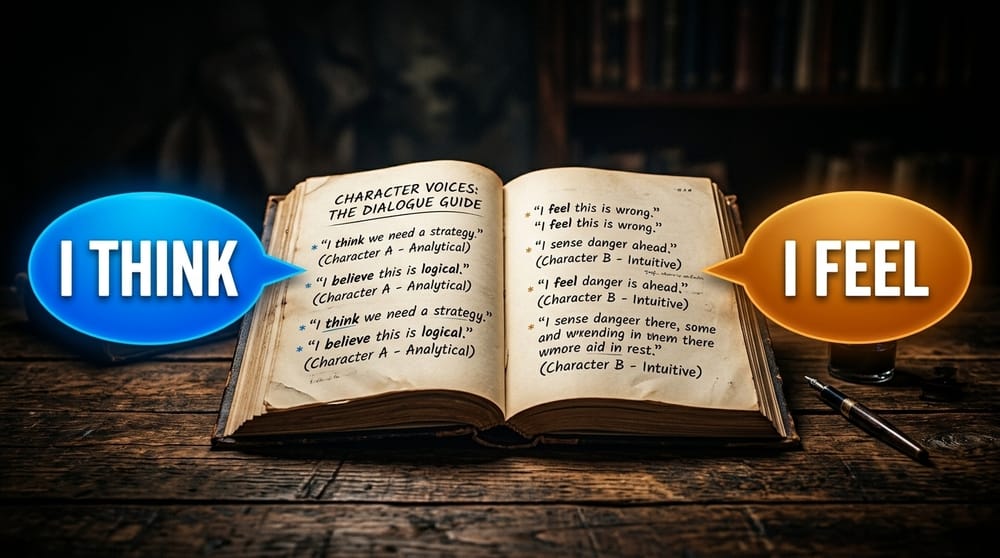
Give ten writers the same scene, the same plot beat, the same decision to make, and you'll get ten different characters if you do one thing right: let each of them process that decision differently. Not just different words. A different operating system.
That operating system usually splits into two camps, and once you see it, you can't unsee it in your own draft.
Two People, Two Default Languages
Some people lead with "I feel." Ask them why they took the job, left the relationship, or drove three hours to see a friend, and the first words out of their mouth locate the emotion. "I feel like I owed her that." "I feel sick every time I think about staying."
Other people lead with "I think." Same decisions, same weight, but the sentence starts in the head. "I think the numbers made the choice for me." "I think staying would have cost more than it saved."
Here's the part writers miss. Both types feel things. Both types think things. Nobody is a robot and nobody is a puddle. The difference is which one gets spoken first, which one the person trusts as the real reason, and which one they reach for under pressure.
That's the whole technique. It's small. It's also the difference between a character sheet full of names and a cast that feels like real, distinct people.
Why Readers Sort Your Characters the Same Way
Readers don't walk around consciously labeling themselves feel-led or think-led. But they read that way anyway, because it's how they read people in real life, and fiction borrows the same wiring.
A feel-led reader tends to warm up fast to a feel-led character. The emotional reasoning feels honest, recognizable, safe. That same reader can find a think-led character standoffish, even when the character is right, even when the character is the hero.
Flip it. A think-led reader often finds a feel-led character exhausting. Too reactive. Too much justifying with emotion when the reader wants a reason. That reader relaxes around a character who thinks out loud, because it mirrors how they themselves would handle the same mess.
Readers don't consciously label your characters as feelers or thinkers, but they sort them anyway, and that sorting quietly decides who gets forgiven and who gets judged.
This is why a story often has a mix. A feel-led protagonist paired with a think-led best friend doesn't just create contrast for dialogue, it widens the net. Different readers latch onto different characters, and both of them still root for the same outcome.
Build It Into the Character Sheet Before You Write a Word
This isn't something to discover on page 140 and retrofit. Decide it early, the same way you'd decide eye color or backstory wound. It belongs on the character sheet, next to motivation and fear.
- Primary mode: does this character default to "I feel" or "I think" when explaining themselves?
- Origin: what taught them to lead that way? A think-led character raised by chaos, a feel-led character raised by cold logic, both are richer than the obvious pairing.
- Stress response: do they double down on their default under pressure, or does it crack and flip entirely?
- Internal narration: does their inner monologue mirror their spoken pattern, or is there a gap worth exploiting?
A character can lean feel in relationships and think at the office. That's nuance, not a contradiction, as long as you decided it on purpose instead of letting it drift.
When You're Wired Differently Than Your Character
Here's the honest problem. If you're a natural feel-led thinker, your think-led characters can come out stiff, over-explained, or quietly unlikable, because you're writing them the way a feel-led person imagines a robot talks. The reverse happens too. Think-led writers often write feel-led characters as melodramatic, because emotional reasoning looks excessive from the outside when it isn't your native language.
Two things help close that gap.
First, go listen to real people who process the way your character does. Transcripts, interviews, podcasts where someone is explaining a hard decision. Pay attention to what they say first, not what they say eventually. The first sentence out of someone's mouth is almost always their default mode.
Second, read authors known for writing the mode you struggle with. If your think-led dialogue always sounds cold, go read a writer who does controlled, logic-forward characters with warmth intact. You're not copying voice. You're studying how logic and warmth coexist in the same sentence.
Same Decision, Two Lenses
Same scene. Same job offer. Same character standing in the same kitchen. Watch what changes when the lens changes.
FEEL-LED
"I feel sick even thinking about it," she said, gripping the letter. "Everyone keeps telling me it's the smart move, and I know it probably is, but I feel like I'd be leaving a piece of myself in this building."
"So don't take it," he said.
"I have to. I just feel like I should hate it a little more before I do."
THINK-LED
"I think the offer's better on paper than the current job in every category that matters," she said, folding the letter along its crease. "Salary, hours, growth. I think staying here would be sentiment overriding the spreadsheet."
"So take it," he said.
"I already have. I think I just needed to say it out loud once before I did."
Same outcome. Same amount of feeling underneath both, because the think-led version still cares, she just doesn't lead with it. Same amount of thinking underneath both, because the feel-led version has clearly done the math too. She just doesn't lead with that either.
Did you catch that? Those two passages just did to you what this whole post is about. You likely warmed up faster to one of them. That reaction wasn't random. It was your own default mode meeting a character built with the same one, or a different one.
Key Takeaways
- Every character has both logic and emotion. The craft move is deciding which one they lead with out loud.
- Readers sort characters into feel and think camps without realizing it, and it shapes who they root for.
- Decide the mode on the character sheet, before drafting, not as an accident of your own voice bleeding through.
- If you're writing against your own default, study real speech patterns and read authors who do the opposite mode well.
Small technique. Big payoff. It costs you nothing but a decision, and it's the kind of decision that makes a cast of characters stop sounding like variations of you.
If you want more of this kind of craft thinking, along with the self-publishing side of turning a finished manuscript into a real book on shelves, there's more waiting for you over at authorhub.io/blog.

Hi, I'm Tim Hewitt
CEO of AuthorHub.io
I won my first writing scholarship in high school by beating more than 300 other writers in a nationwide contest, and that award gave me something money couldn't buy: the belief that my words mattered. Since then I've spent decades learning what makes writing work: how to find your voice, how to keep readers turning pages, marketing that really sells books, and how to spot the small craft problems that quietly sink good stories. This blog is where I share everything I've picked up along the way.