
Murder Your Darlings: T-Shirt Contest Winner
Sunday, March 15, 2026
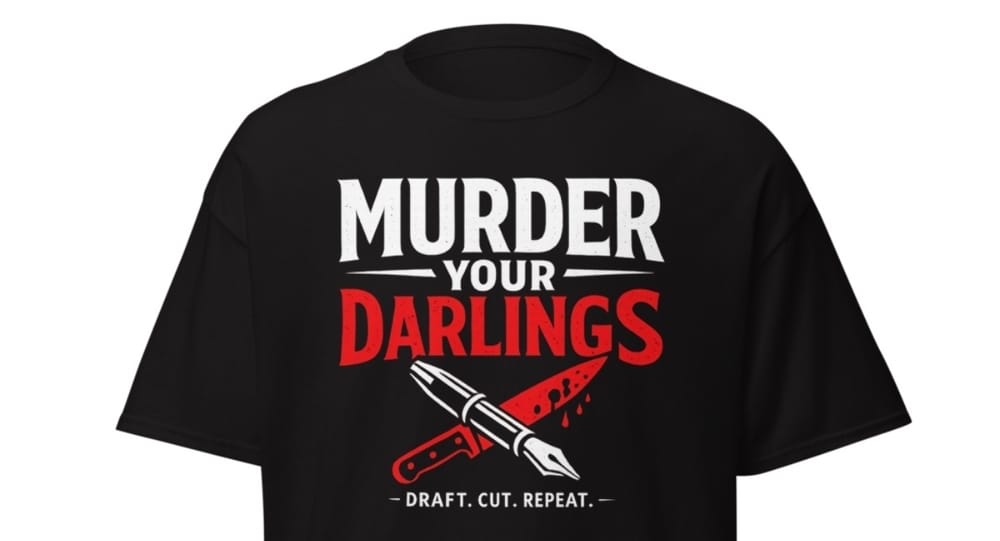
When AuthorHub launched its first community t-shirt design contest, no one quite anticipated the storm of debate, laughter, discomfort, and ultimately, recognition that one submission would ignite. The winning design - bold white and red lettering on a jet black tee reading "Murder Your Darlings. Draft. Cut. Repeat." - didn't just win a contest. It started a conversation that spread far beyond the writing community and into coffee shops, bookstores, and social media threads everywhere.
A Majority Vote in a Divided Room
The contest drew over 60 design submissions from AuthorHub members as well as writers Facebook groups - everything from minimalist quill-and-inkwell motifs to elaborate typographic tributes to classic literature. Community members cast their votes over a two-week period, and the results were striking: "Murder Your Darlings. Draft. Cut. Repeat." claimed a clear majority, pulling ahead with nearly 48% of all votes cast.
What made the victory particularly fascinating was that it came despite - or perhaps because of - a deeply polarized reaction. The comment threads beneath the design were split almost down the middle. Writers cheered. Non-writers recoiled. And that tension, it turned out, was precisely the point.
AuthorHub's community manager, in announcing the winner, summed it up perfectly: "We wanted a design that felt authentically ours - something that only a writer would truly understand. We got that, and then some."
The Phrase That Every Writer Knows
"Murder your darlings" is one of the most enduring pieces of writing advice in literary history. Often attributed to Sir Arthur Quiller-Couch - though echoed by writers from William Faulkner to Stephen King - the phrase speaks to one of the most painful and necessary acts in the craft: cutting the passages, characters, subplots, and sentences you love most, when they no longer serve the story.
Every writer who has spent hours crafting a perfect paragraph only to delete it in revision knows the visceral truth behind those words. It's not destruction for its own sake - it's discipline. It's the recognition that attachment to your own cleverness can be the enemy of a better story. The design's second line, "Draft. Cut. Repeat.", transforms the famous maxim into something even more resonant: a process. A cycle. The unglamorous, essential rhythm of writing well.
- Draft: Pour your story out, darlings and all, without judgment or restraint.
- Cut: Return with clear eyes and a willingness to sacrifice what doesn't serve the whole.
- Repeat: Understand that great writing is almost never written; it is rewritten, again and again.
For working writers, seeing this loop printed on a t-shirt isn't morbid - it's validating. It acknowledges the real labor behind storytelling, the part that rarely gets celebrated in interviews or author bios. The design wears the editing process like a badge of honor.
A Conversation Starter Hiding in Plain Sight
One of the most compelling arguments made by voters in favor of the design was its power to open doors. Wearing a shirt that says "Murder Your Darlings" in public is practically a guarantee that someone will ask about it. And that moment - that double-take, that raised eyebrow, that cautious "...what does that mean?" - is an invitation.
Writers who participated in AuthorHub's post-vote discussion described the design as a kind of social shorthand. Spot someone in the same shirt at a bookstore, and you already know something meaningful about them. Meet a curious stranger on a train, and suddenly you're explaining what it really means to love a piece of writing enough to let it go. These aren't trivial exchanges - they're the kinds of conversations that can make someone feel seen in their creative struggle, or inspire a hesitant writer to finally trust the editing process.
One AuthorHub member wrote in the contest thread: "I wore the prototype to my writing group and within ten minutes we were deep in a conversation about the chapter I'd been too afraid to cut for six months. The shirt did the work before I even opened my mouth."
Embracing the Mantra: Writers on Cutting Their Work
The editing phase is where manuscripts are truly made - and where many writers struggle the most. The romantic image of writing involves inspiration and creation, not the cold surgical work of removing thousands of words you spent weeks producing. Yet seasoned writers will tell you that learning to cut is the skill that separates a good story from a great one.
AuthorHub members shared their own "darling murders" in a thread sparked by the design's win. Stories poured in: a beloved prologue deleted after three drafts because it slowed the opening. A secondary character who existed for two hundred pages before being cut entirely because they diluted the protagonist's arc. A lyrical passage - the author's personal favorite sentence in the entire manuscript - removed because it called too much attention to itself and broke the story's momentum.
What united these stories wasn't grief - it was growth. Almost every writer who shared a "darling murder" described the manuscript becoming measurably stronger afterward. The shirt's slogan captures that paradox: the most loving thing you can do for your story is sometimes to take something away from it.

The Controversy: When Context Gets Lost
Not everyone was charmed. As screenshots of the winning design circulated beyond AuthorHub's community and into the general Facebook universe, a vocal minority raised objections - some concerned, some outraged. Stripped of its literary context, the phrase "Murder Your Darlings" reads very differently. Several social media users flagged it as alarming, with some suggesting the shirt glorified or normalized violence.
The reaction was predictable in retrospect, and in many ways, it only deepened the design's cultural resonance. Language that operates on multiple registers - that means one thing to an initiated audience and something entirely different to an outsider - has always been one of the most powerful tools in a writer's kit. The shirt, unintentionally, was demonstrating the very principle it described: context shapes meaning. Interpretation is everything.
AuthorHub addressed the controversy directly in a community post, explaining the literary origins of the phrase and its significance in writing culture. The response was largely positive - many people who had initially reacted with alarm came away with a new appreciation for the idiom and, by extension, for the craft of writing itself. The controversy, in other words, became another kind of conversation starter.
Some members of the writing community even argued that the controversy was a feature, not a bug. A shirt that generates this kind of reaction - that makes people stop, question, and engage - is doing something far more interesting than one that simply pleases everyone at a glance. It provokes. And provocation, handled thoughtfully, is one of storytelling's oldest and most essential tools.
Why This Design Matters Beyond the Contest
Ultimately, the victory of "Murder Your Darlings. Draft. Cut. Repeat." says something meaningful about what the AuthorHub community values - and perhaps about what the broader writing community needs to see reflected back at itself more often.
Writing culture has a tendency to romanticize the generative side of the process: the inspired first draft, the midnight revelation, the story that seemed to write itself. What gets talked about less is the long, unglamorous work of revision - the drafts that go nowhere, the scenes that have to be torn out, the willingness to start over when the structure isn't working. The shirt refuses to let that part of the process hide.
In choosing this design, AuthorHub's community chose honesty over polish. They chose to celebrate the full arc of the writing process - not just the beautiful beginning, but the brutal, necessary middle. And in doing so, they created something that writers can wear not just as a piece of merch, but as a declaration of what they actually do and who they actually are.
- full reality It honors the of the writing process, not just the romantic parts.
- instant community It creates among writers who recognize the reference.
- invites conversation It with non-writers, opening a window into the craft.
- provokes thought And even controversy - about language, meaning, and context.
- editing process It wears the as a badge of honor rather than a shameful secret.
The next time you sit down to revise a manuscript - to cut the scene you love, to delete the paragraph you spent an afternoon perfecting, to murder another darling in service of a better story - remember that you're not alone in that act. Somewhere out there, a writer in a bold black-and-white t-shirt is doing the same thing. Draft. Cut. Repeat. It's not a warning. It's a war cry. And it won, by majority vote, because it's true.
The AuthorHub Community decided to make this T-Shirt available to a wide audience. If you are interested in grabbing your own "Murder Your Darlings" tee, you can do so [At This Link].

Hi, I'm Tim Hewitt
CEO of AuthorHub.io
I won my first writing scholarship in high school by beating more than 300 other writers in a nationwide contest, and that award gave me something money couldn't buy: the belief that my words mattered. Since then I've spent decades learning what makes writing work: how to find your voice, how to keep readers turning pages, marketing that really sells books, and how to spot the small craft problems that quietly sink good stories. This blog is where I share everything I've picked up along the way.