
Talk Your Book Into Life: Why Wispr Flow is a Game-Changer for Authors
Tuesday, July 14, 2026
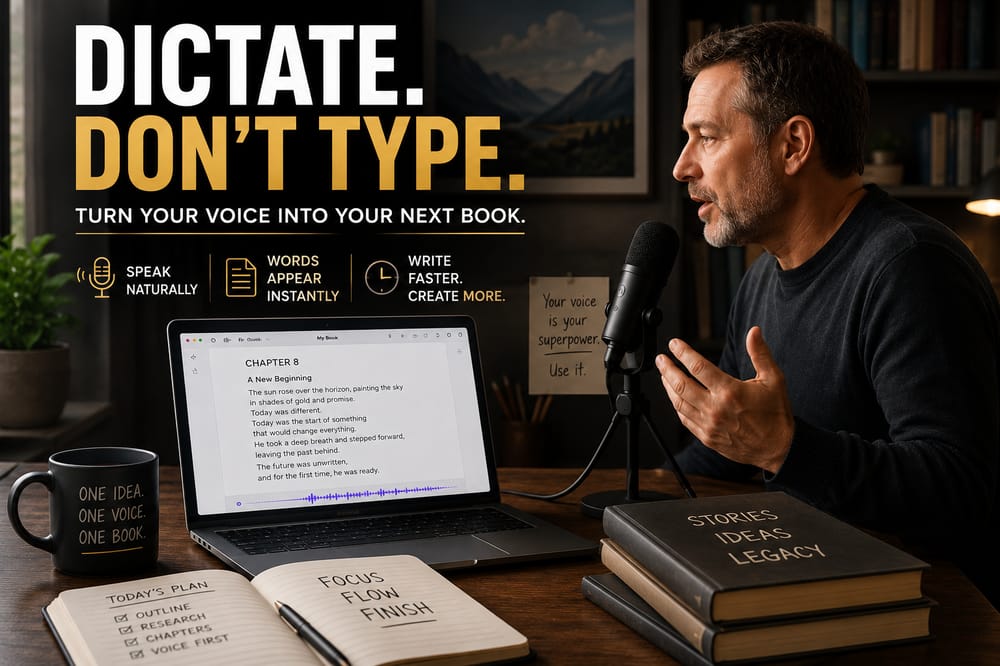
What if your best writing sessions didn't involve a keyboard at all? What if the fastest path from your imagination to the page was simply... your voice?
I know. You've heard this before. You tried dictation. Maybe you tried it with Dragon NaturallySpeaking back in the day, or you fumbled around with your phone's built-in voice-to-text and ended up with something that looked like a ransom note written by a caffeinated toddler. Every "um," every false start, every half-formed thought dumped directly onto the page in all its unfiltered, chaotic glory.
You gave up. I don't blame you. Traditional speech-to-text was a mess - and cleaning up that mess took longer than just typing the whole thing in the first place.
But something has changed. And I want to tell you about it - because it has genuinely, fundamentally, irreversibly changed the way I write.
Why Dictation Has Always Let Authors Down
Here's the fundamental problem with traditional speech-to-text: it's too honest.
It transcribes everything. Every "um." Every "uh." Every "wait, no, I mean - actually, let me start that again." Every time you trail off mid-sentence because you lost your train of thought, it faithfully records the silence and then the stumble back in. It has no idea what you meant to say. It only knows what you actually said.
The result? You'd dictate for twenty minutes, feel incredibly productive, open the document, and find something that looked like a transcript of a nervous person giving a speech at a wedding. Technically your words. Completely unusable prose.
And punctuation? Forget it. You'd either have to say "period" and "comma" out loud like some kind of human telegraph machine, or you'd end up with one enormous run-on paragraph that went on forever and ever without stopping because who talks in sentences really when you think about it we just sort of keep going until we don't.
Dictation, for most authors, was a promise that never delivered. A great idea in theory. A nightmare in practice.
"Traditional speech-to-text was a promise that never delivered. A great idea in theory. A nightmare in practice. Until now."
Enter Wispr Flow - And Everything Changes
Wispr Flow does something fundamentally different from every dictation tool that came before it. It doesn't just transcribe what you say. It processes what you say - using AI - before it ever touches the page.
Think about what that means. You speak naturally. You ramble a little. You say "um" four times in one sentence. You restart a clause halfway through. And Wispr Flow listens to all of it, understands what you were actually trying to say, and delivers clean, readable text - stripped of the filler, the false starts, and the verbal clutter that makes traditional dictation output so painful to work with.
It's the difference between a raw recording of your voice and a professionally edited transcript. Except it happens in real time. Except it's free of the tics and habits that make your spoken language so different from your written language.
You just... talk. And what appears on screen is something you could actually use.
What Makes Wispr Flow Special for Authors
Let me get specific, because the details here matter enormously if you're a writer.
Dictate Full Paragraphs Without Chasing Perfection
With traditional dictation, you had to think in clean sentences - because every word went straight to the page. With Wispr Flow, you can think out loud. You can work through an idea as you speak it, backtrack, refine, and let the AI figure out what you meant. That freedom is extraordinary for creative writing. It lets you stay in the flow state instead of constantly self-editing before you've even started.
Automatic Dialogue Formatting - Fiction Writers, This Is For You
This one stopped me in my tracks when I first discovered it. When you're dictating fiction and a character speaks, Wispr Flow automatically wraps their dialogue in quotation marks. You don't have to say "open quotes" and "close quotes" like some kind of Victorian telegram operator. It recognises dialogue and formats it correctly. For novelists, this is not a small thing. This is a game-changer.
Works Across Every App You Use
Wispr Flow isn't locked to one program. It works system-wide - in Scrivener, Storyist, Word, Google Docs, your email client, your browser, your notes app, everywhere. Wherever you can type, you can now dictate. That's a completely different proposition from a dedicated dictation app that requires you to record there and then paste somewhere else.
Mac, iPad, iPhone - Write Wherever You Are
Wispr Flow is available across your entire ecosystem. That means you can dictate a scene on your Mac at your desk, pick up your iPhone while you're waiting for a coffee, and continue on your iPad on the couch in the evening. Your writing life doesn't have to be chained to one machine. Your voice goes with you everywhere.
It Learns Your Voice and Your Style
The more you use Wispr Flow, the better it gets. It adapts to your accent, your vocabulary, your cadence. If you use genre-specific terminology, character names, or unusual words, it gets better at recognising them over time. Week by week, the accuracy improves. The output gets cleaner. The editing burden gets lighter.
I've Dictated Over 100,000 Words With This Tool
I want to be clear: I'm not writing about Wispr Flow because I tested it for a week and thought it was interesting. I'm writing about it because it has completely replaced typing in my life.
I have dictated over 100,000 words using Wispr Flow at an average speed of 155 words per minute. It's on every computer I own. It's on my iPad. It's on my iPhone. Every app I use, I use with Wispr Flow. Blog posts, book chapters, emails, notes, outlines, social media captions - all of it, dictated. The keyboard still gets used, but it's no longer the primary instrument of my writing life.
My voice is. And that's a sentence I genuinely never expected to write.
"I have dictated over 100,000 words using Wispr Flow. It's on every computer I own, my iPad, and my iPhone. This isn't a tool I tested - it's a tool I live by."
Let's Be Honest: You'll Still Edit
I'm not going to pretend that Wispr Flow produces publication-ready prose. It doesn't. And any tool that claimed to do that would be lying to you.
What it produces is a genuinely usable first draft. The kind of first draft that, with a little practice, requires significantly less editing than you might expect. The AI is good - impressively good - at understanding what you meant rather than just what you said. But it's not a developmental editor. It's not going to fix a scene that isn't working. It's not going to tell you that your pacing is off.
Think of Wispr Flow as a first draft accelerator, not a first draft replacer. You still do the creative work. You still make the artistic decisions. You still edit. But the raw material arrives faster, and in better shape, than anything you'd get from traditional dictation - or, for many writers, from typing.
Give it a few weeks. Let yourself get comfortable with speaking your prose. You'll be surprised how quickly the output quality improves - and how quickly your editing burden shrinks.
Three to Four Times Faster. That's Not a Typo.
The average person types somewhere between 40 and 60 words per minute, and very experienced typists can get as high as 90 wpm. The average person speaks at 120 to 180 words per minute. That's not a small difference. That's a multiplier. That's the difference between writing 500 words in an hour and writing 2,000.
For authors who struggle to get words on the page - whether because of time constraints, creative blocks, or the sheer psychological weight of the blank document - that multiplier is transformative. But for authors dealing with physical limitations, it's something more than transformative. It's liberating.
RSI. Arthritis (that's me). Repetitive strain from years at a keyboard. Injury. Chronic pain. These are realities for more writers than most people realize, and they are realities that can make writing genuinely painful - or impossible. Wispr Flow doesn't just make writing faster. For some authors, it makes writing possible again.
3-4x
Faster than typing
100K+
Words dictated personally
Every
App. Every device.
Your Book Is Waiting. Your Voice Is Ready.
If you've been struggling to get words on the page - if every writing session feels like pulling teeth, if the blank document has become your nemesis, if you've tried dictation before and given up in frustration - I want you to try this. Not because I'm telling you it's perfect. But because I'm telling you it's different.
Wispr Flow is the first dictation tool I've used that treats your voice with the intelligence it deserves. It doesn't just capture what you say. It understands what you mean. And for authors, that distinction is everything.
Think about what you could do with three times your current word count output. Think about finishing that chapter you've been circling for weeks. Think about your book - the one that's been living in your head, waiting for you to find a way to get it out.
Your voice might just be the key that unlocks it.
Ready to Talk Your Book Into Existence?
Try Wispr Flow and discover what your writing life looks like when your voice does the heavy lifting. It's one of the best investments in your writing productivity you'll ever make.
I wrote this post by dictating it. Every word of it. And I didn't think about that once while I was doing it - because that's the point. The tool disappears, and the writing begins.

Hi, I'm Tim Hewitt
CEO of AuthorHub.io
I won my first writing scholarship in high school by beating more than 300 other writers in a nationwide contest, and that award gave me something money couldn't buy: the belief that my words mattered. Since then I've spent decades learning what makes writing work: how to find your voice, how to keep readers turning pages, marketing that really sells books, and how to spot the small craft problems that quietly sink good stories. This blog is where I share everything I've picked up along the way.