
The Ethics of Innovative Self-Publishing Tactics: Lessons from 'Wool' and Beyond
Saturday, May 23, 2026
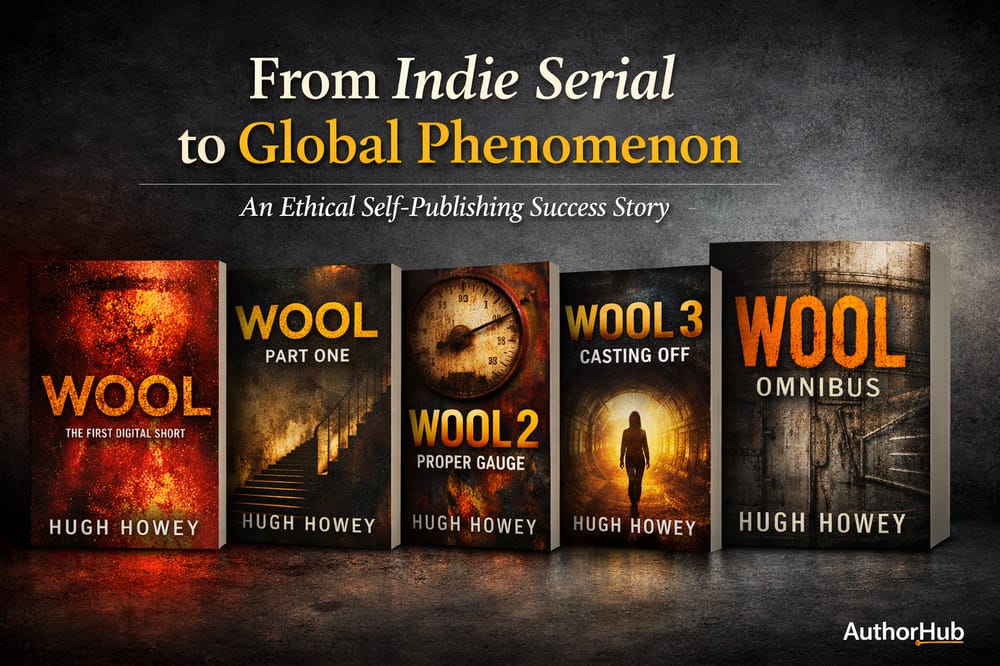
In the world of self-publishing, success stories often carry a hidden underbelly. For every author who rises to the top through sheer talent and relentless hustle, there are others who blur the line between clever marketing and outright manipulation. The stories of how some books become bestsellers reveal uncomfortable truths about the systems we trust - and the lengths people will go to in order to game them.
The Wool Phenomenon: A Self-Publishing Fairy Tale With Footnotes
Hugh Howey's Wool is one of the most celebrated self-publishing success stories of the past decade. Originally released as a short story on Amazon's Kindle Direct Publishing platform in 2011, it grew into a sprawling series that captured the imaginations of science fiction readers worldwide. By 2013, Howey had secured a print-only deal with Simon & Schuster while retaining his digital rights - an almost unheard-of arrangement that signaled a seismic shift in the publishing industry.
But the road to that deal wasn't paved solely with great prose. Howey was remarkably transparent about his approach to Amazon's ecosystem. He understood that Amazon's algorithms rewarded velocity - rapid sales in a short window would push a book higher in the rankings, which in turn generated more visibility and more organic sales. It was a virtuous cycle, but only if you could trigger the initial momentum.
Howey priced his initial short story at just $0.99, an aggressive strategy designed to lower the barrier to impulse purchases. He then released subsequent installments in rapid succession, keeping readers hooked and generating a steady stream of sales that Amazon's algorithm interpreted as surging demand. He engaged voraciously with readers on forums, blogs, and social media, building a grassroots following that amplified every new release. He also encouraged reviews - lots of them - understanding that social proof was the currency of Amazon's marketplace.
None of this, on its face, is unethical. Pricing strategically, publishing frequently, and engaging with readers are hallmarks of smart indie publishing. But the Wool story raises a more nuanced question: when does understanding the system become gaming the system?
A number of people accused Howey of buying $5000 worth of his own book to drive up the sales numbers, and though that rumor circulated widely, it was never confirmed and since we know Amazon pays attention to both bulk buys and IP addresses that purchase multiple copies, it's highly likely it was just sour-grapes from people whose launches were not as successful.

Howey himself became a vocal advocate for self-publishing, and his transparency about strategy was both admired and criticized. Some industry observers pointed out that his approach - while legal and technically within Amazon's terms of service - exploited algorithmic blind spots. Amazon's ranking system doesn't distinguish between a thousand readers who discovered a book organically and a thousand readers who were funneled through a carefully orchestrated promotional blitz. The result looks the same on the bestseller list, but the underlying reality is very different.
The broader concern is that strategies like these create an uneven playing field. Authors who write exceptional books but lack marketing savvy - or the resources to execute complex promotional campaigns - get buried beneath those who understand how to manipulate visibility algorithms. The bestseller list, which readers trust as a signal of quality and popularity, becomes something more like a leaderboard for marketing sophistication.
The Consignment Scheme: Manufacturing Demand at the Local Level
While Howey's story plays out on the digital stage, a quieter but equally instructive example comes from the world of independent bookstores. This is a story that has circulated in publishing circles for years, and while the specific names are often kept anonymous to protect reputations, the pattern is well-documented.
An aspiring author, unable to secure a traditional publishing deal, decided to take matters into their own hands. They self-published their novel and approached a well-respected independent bookstore about carrying it on consignment - a common arrangement where the store agrees to stock the book and pays the author only when copies sell. The bookstore, supportive of local authors, agreed.
Here's where the story takes a turn. The author then orchestrated a campaign among friends, family members, and acquaintances, asking them to visit the bookstore over a concentrated period and purchase copies of the book. Some accounts suggest the author even reimbursed buyers for their purchases, and sent the same books back to the bookstore to sell again. The result was predictable: the book appeared to be selling briskly. The bookstore, impressed by the apparent demand, reordered. The author repeated the cycle.
Within weeks, the book had generated enough "sales" to catch the attention of a regional distributor. The author used these numbers - real transactions, technically speaking - to pitch literary agents and publishers, claiming organic market validation. In some versions of this story, the author eventually secured a modest publishing deal on the strength of these manufactured sales figures.
The short-term results were impressive. But the long-term consequences were more complicated:
- The bookstore was deceived. Their decision to reorder was based on false demand signals. When the coordinated purchases stopped, the book sat unsold, costing the store shelf space and revenue.
- The publisher was misled. Any deal secured on the basis of manufactured sales data was built on a foundation of dishonesty. When the book failed to perform in wider release, it damaged the author's credibility - and the publisher's trust in self-reported sales data.
- The community was harmed. Independent bookstores operate on razor-thin margins. Every consignment slot given to a book with fake demand is a slot taken from a book with genuine potential. The ripple effects touch other authors, booksellers, and readers.
- The author's reputation was at risk. Publishing is a small world. When the scheme came to light - as these things inevitably do - the author's name became associated with manipulation rather than talent.
The Thin Line: Smart Strategy vs. Manipulation
These two stories sit at different points on a spectrum, but they illuminate the same fundamental tension in modern publishing: the systems that determine visibility and success can be gamed, and the line between strategic marketing and manipulation is often disturbingly thin.
Consider the practices that have become commonplace in self-publishing and ask yourself where you'd draw the line:
- Pricing at $0.99 to drive volume? Many people would call this smart pricing strategy.
- Coordinating a launch-day push with your email list? Standard practice, and generally considered ethical.
- Asking friends and family to leave reviews? This enters grayer territory - Amazon explicitly prohibits reviews from people with a personal relationship to the author.
- Purchasing your own book to boost rankings? Most would agree this crosses a line.
- Paying for a service that coordinates bulk purchases to hit a bestseller list? This is a well-documented practice that major publishers have engaged in, and it remains deeply controversial.
The challenge is that none of these tactics exist in a vacuum. Each one operates within an ecosystem of trust - trust between readers and bestseller lists, between bookstores and authors, between publishers and sales data, and between the broader community of writers who are all trying to be heard.
When that trust erodes, everyone suffers. Readers become cynical about recommendations. Bookstores become reluctant to take chances on unknown authors. Publishers become more risk-averse. And the authors who play by the rules find it harder than ever to break through.
The Reputation Economy
Here's what the most successful long-term authors understand: your reputation is your most valuable asset, and it compounds over time - in both directions.
Hugh Howey, to his credit, has been remarkably open about his methods, and his success is ultimately grounded in genuinely compelling storytelling. Readers who discovered Wool through algorithmic nudges stayed because the book was good. His marketing accelerated discovery, but it didn't fabricate quality. That distinction matters enormously.
The consignment scheme author, by contrast, built on a foundation of manufactured demand. When the scaffolding was removed, there was nothing underneath. The book couldn't sustain itself because the "demand" was never real. And worse, the deception - once discovered - became the defining narrative of that author's career, overshadowing whatever merit the book might have had.
The publishing world has a long memory. Agents talk to each other. Editors share notes. Bookstore owners compare experiences. In an industry built on relationships, a single act of manipulation can close doors that never reopen.
Balancing Innovation With Integrity
So how do you market aggressively without crossing ethical lines? How do you leverage systems and platforms without exploiting them? Here are some principles worth considering:
1. The Transparency Test
Ask yourself: Would I be comfortable if every detail of this marketing strategy were made public? If your approach requires secrecy to work, that's a red flag. Howey's pricing and release strategies were openly discussed and widely imitated - because there was nothing to hide. The consignment scheme required deception at every step.
2. The Sustainability Test
Does your strategy create genuine, lasting demand, or does it create a temporary illusion? Tactics that depend on one-time manipulations - bulk purchases, fake reviews, coordinated buying schemes - produce spikes that inevitably collapse. Strategies that build real audiences - email lists, reader communities, consistent quality - create sustainable careers.
3. The Ecosystem Test
Consider the broader impact. Does your strategy strengthen or weaken the ecosystem you depend on? When authors game Amazon's algorithms, they degrade the platform's ability to surface genuinely popular books - which ultimately hurts all authors, including themselves. When someone manipulates a bookstore's consignment system, they make that store less likely to support indie authors in the future.
4. The Quality Foundation
The most ethical marketing strategy in the world won't save a bad book, and the most manipulative scheme can't sustain one. Before investing energy in marketing tactics, invest in the work itself. Professional editing, thoughtful cover design, genuine beta reader feedback - these aren't just ethical choices, they're strategic ones. A great book is the best marketing tool that exists.
The Bigger Picture
Self-publishing has democratized access to readers in ways that would have been unimaginable twenty years ago. That democratization is a profound good. But with that freedom comes responsibility - not just to ourselves and our careers, but to the community of authors, readers, booksellers, and publishers who make the literary ecosystem function.
Every time an author games a system, it creates pressure for other authors to do the same. It normalizes manipulation. It shifts the competitive landscape from "who can write the best book" to "who can most effectively exploit the platform." That's a race to the bottom that nobody wins.
The authors who build lasting careers - the ones who are still publishing and still beloved ten, twenty, thirty years from now — are the ones who understood that integrity isn't a constraint on success. It's the foundation of it. They marketed aggressively, priced strategically, and leveraged every platform available to them. But they did so in ways that created genuine value for readers and strengthened the community they belonged to.
The question isn't whether you can game the system. In most cases, you can. The question is whether the version of success you build that way is one you can live with - and one that will last.
This post is part of an ongoing series exploring the intersection of marketing ethics and self-publishing strategy. The examples discussed are drawn from publicly available accounts and industry reporting. Specific details have been generalized where appropriate to protect individual privacy.

Hi, I'm Tim Hewitt
CEO of AuthorHub.io
I won my first writing scholarship in high school by beating more than 300 other writers in a nationwide contest, and that award gave me something money couldn't buy: the belief that my words mattered. Since then I've spent decades learning what makes writing work: how to find your voice, how to keep readers turning pages, marketing that really sells books, and how to spot the small craft problems that quietly sink good stories. This blog is where I share everything I've picked up along the way.